Return to Civilization
Jan 29, 2024
The crummy weather that was supposed to arrive this afternoon accelerated and hit us around four a.m. The boat spun a circle during the wind direction swap and put us in a rather precarious situation. Last night, one of our neighbors dropped anchor right in front of us but due to the wind switching directions, ended up directly behind us this morning. This made them unable to move as we were directly over the top of their anchor.
Rather than waiting to see if we drag and run into them, my parents opted to relocate. Jules and I received an early morning knock on the door and a request to assist in hauling the anchor. I grabbed my glasses and rushed out to help. My dad already had the engines running so I headed onto the bow.
The moment I opened the door, I realized the wind was absolutely whipping. Luckily we have had plenty of practice and made quick work of bringing in the anchor despite the winds. The people on the other boat stood on their bow taking pictures of us as if the situation was our fault.
Nothing happened so it doesn’t really matter, but I’m definitely pointing my finger at them. I don’t think they were paying close enough attention to the wind and made the mistake of anchoring too close. It can happen to the best of us I suppose. We certainly ended up too close to a neighboring boat downtown in Fort Lauderdale. They were nice enough to not say anything and simply moved further away, this time it was our turn.
We headed a short distance north and cozied up close to Jimmy Cay. On the way I saw wind speeds exceeding thirty knots! Once we were in position I headed back to the bow and dropped the anchor. The wind collided with the side of the boat and accelerated us backwards rapidly. The chain started to vibrate as it was being pulled out faster than our windlass could feed; luckily my dad was able to buffer our speed with the motors. The second I saw the chain reach our hundred feet mark I locked it down and it pulled tight instantly. Thank god the anchor set hard and we didn’t have to go through that a second time.
The combination of strong winds, crummy neighbors, and an early wake up call, had my stress level absolutely peaking. By the time we had gotten reset and motors turned off Jules was just emerging from our bedroom. She’s never been much of a morning person. Sadly the weather confined us to the boat for the entire day once again.
The only excitement was making the decision to jump down to Georgetown tomorrow morning and fish along the way. Otherwise it was a great day to play some more cards. We are all going to be cribbage masters by the time this trip is over. Maybe we’ll head to Nevada to play in the Tournament of Champions.
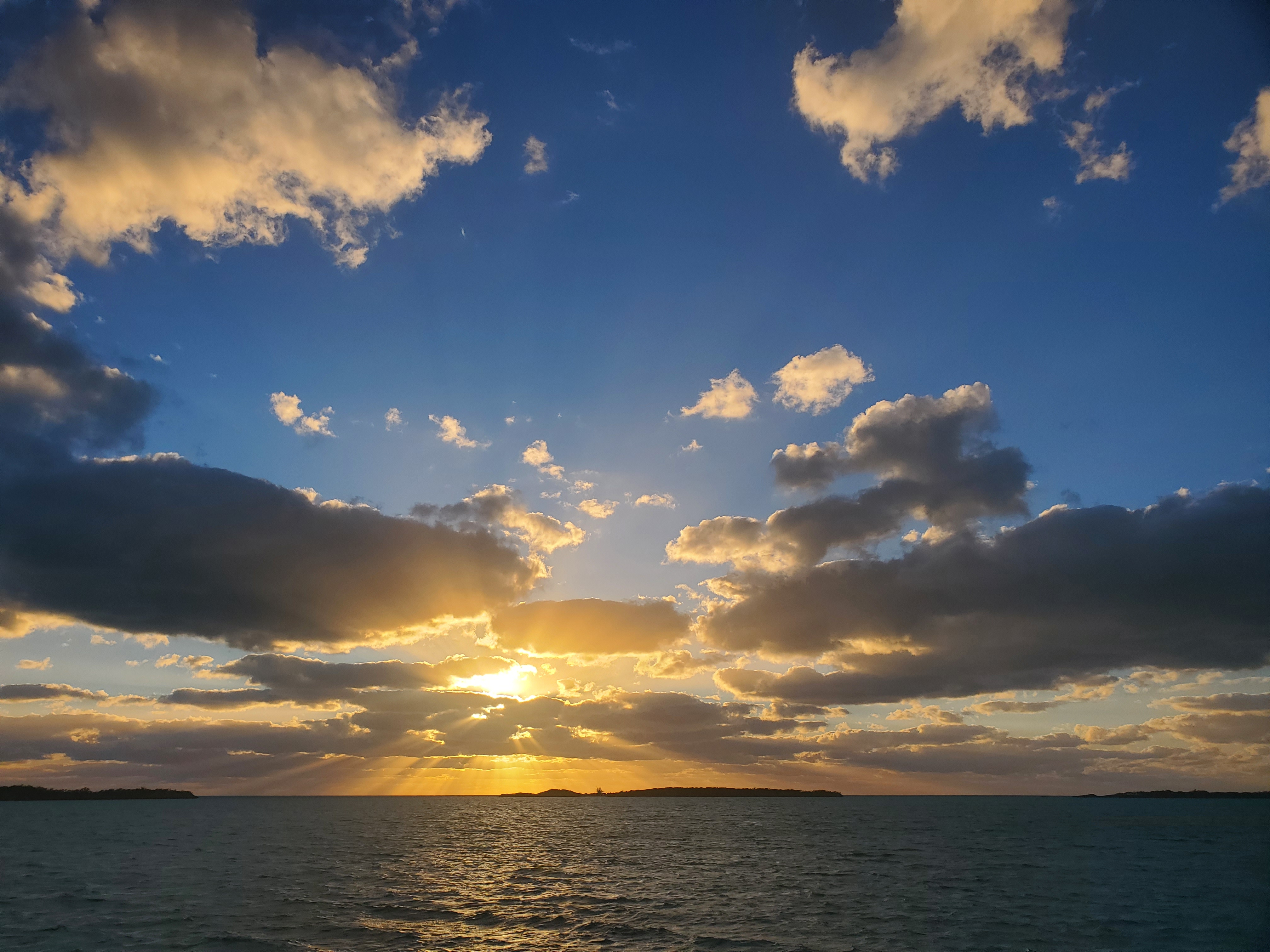
At least we got a nice sunset
Jan 30, 2024
Every finger and toe on the boat was crossed this morning in hopes of catching a fish. Shortly after pouring coffee, we were on the move. We cruised south along Rudder Cut Cay and made our way into the deep blue through the aptly named Rudder Cut. I wonder what came first, the channel or the island?
While my dad drove, Jules and I moved the poles into position and picked out some lures. We decided on two squids and a diver and got them in the water immediately. George Town is about four hours away through the Exuma Sound and we didn’t want to waste a second. We haven’t had fresh fish since before the new year when we caught two mahi-mahi near Bimini.
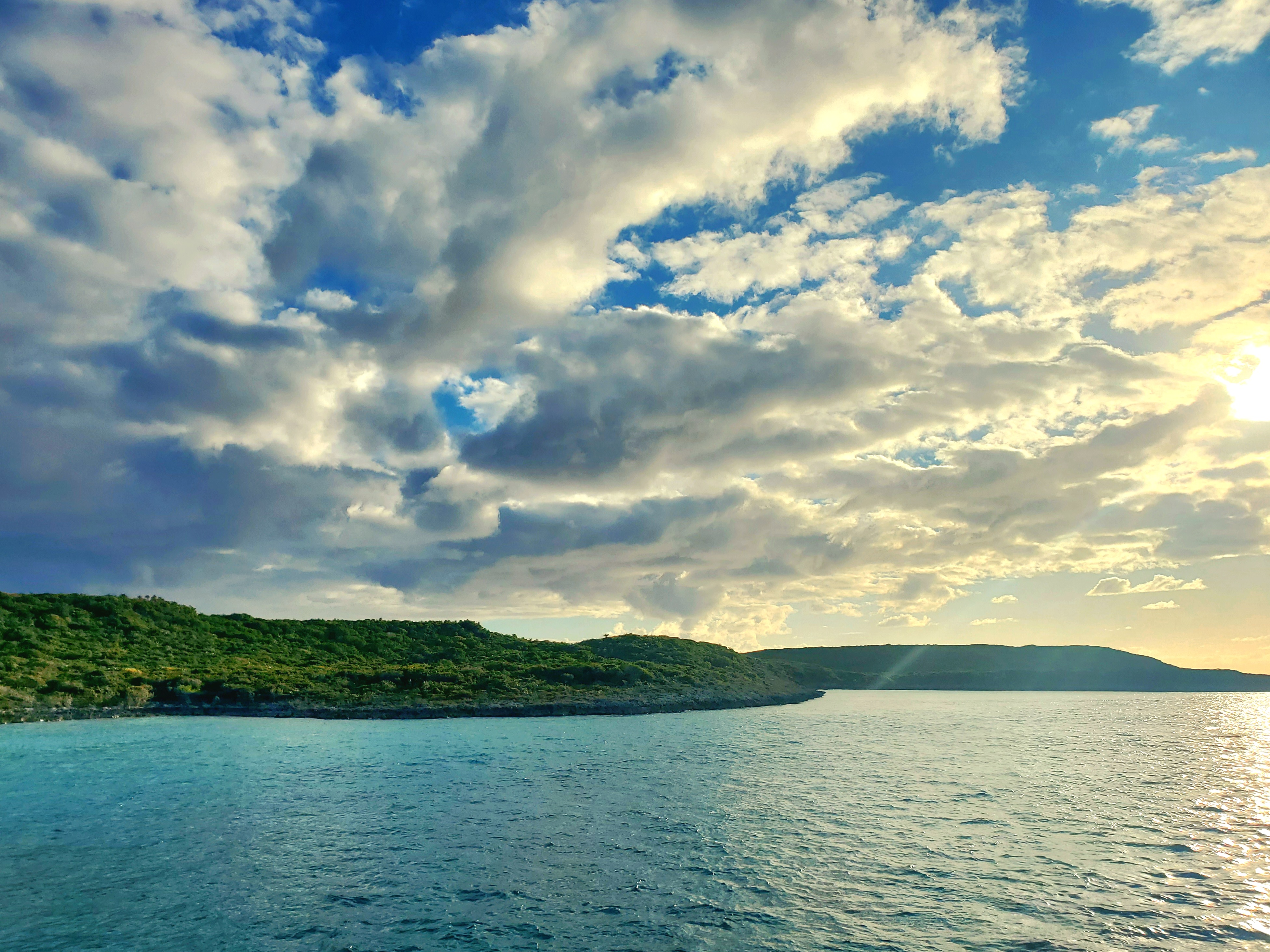
Saying goodbye to Musha Cay
I took the first watch in the cockpit and slowly the morning ticked by. My mind wandered back to our last few times fishing; we didn’t even get a bite. As my doubts began to race I started questioning our setup, did we choose the right baits? Did we let out too much line? Maybe not enough line? Are the baits fouled together?
After a while, my dad came down and decided to switch things up. Rather than change baits he added another and we altered the position of the rods to better accommodate towing all four. My hopes began to diminish and I decided to trade out with my mom and dad. I headed up to the pilothouse to drive with Jules in an attempt to swap around our luck. The morning sun was roasting through the windows as she and I steered us back and forth over the shelf.
Shortly after we took over, Jules started seeing flying fish gliding away from the bow of the boat. Generally they are a good sign. Hopefully we can fool some of their predators with our lures. That’s when it all started to happen. I heard the simultaneous scream of the drag ripping out and my mom yelling “FISH ON!” I pulled the throttle back to an idle and Jules and I ran to assist.
She and I hadn’t even made it down the stairs before my mom amended her previous statement yelling “TWO FISH ON!” We still hadn’t arrived on the aft deck to help and she revised her announcement again screaming “THREE FISH ON!”
As we scrambled down the stairs, I noticed that my dad wasn’t present. Jules and I both assumed our positions on the bent rods and started reeling hard. We all screamed in unison for my dad to come help; of course he was in the engine room at the worst possible time. Luckily he heard the engines back off when I slowed them down and rushed outside. He went to the pilot house to stop the boat and then appeared behind us with the gaff ready to go.
Similar to our fiasco in Bimini, the fish began flanking the boat to the left and right. My mom and Jules were both fighting their fish on the starboard side of the cockpit and managed to bring them in close fairly quickly. In the midst of the chaos I looked down and saw one of the hooked fish with a big shark right behind it. It was a mahi-mahi that was in serious danger of becoming half of a mahi. I yelled out to the others about the shark but I seriously doubted there was anything we could do if he decided to steal our lunch.
Directly beneath us, the bright yellow-green of a dozen other mahi-mahi danced through the water as they scrambled to avoid the predator. Jules reeled her fish into a good position and, after a wild lunge or two, my dad landed a hit with the gaff bringing it in before the shark could take a bite. Of course it started flailing around and slinging blood everywhere around her feet. She worked to subdue the fish and avoid the sharp hooks on the floor while the waves pitched the boat side to side and the floor grew more slippery by the second.
At that point I had been reeling non stop and hadn’t gained an inch. My arm cranked and cranked but the spool of line wasn’t budging. My mom’s fish had managed to wrap around my line and was joining mine in flanking to the port side but soon she got it pulled up against the side of the boat. My dad grabbed her line with his hands, abandoning the gaff altogether, and slung it over the wall. Two fish down, one to go.
The one on my line had nearly swam to the front of the boat. The rod bent backwards toward my face and I began to worry if it could break from the awkward angle. My dad assured me it was fine and I bared down trying to turn the fish around. He looked toward the front of the boat and saw a big mahi come flying out of the water. The moment the words “that’s a nice fish” came out of his mouth the line broke and the fight was over.
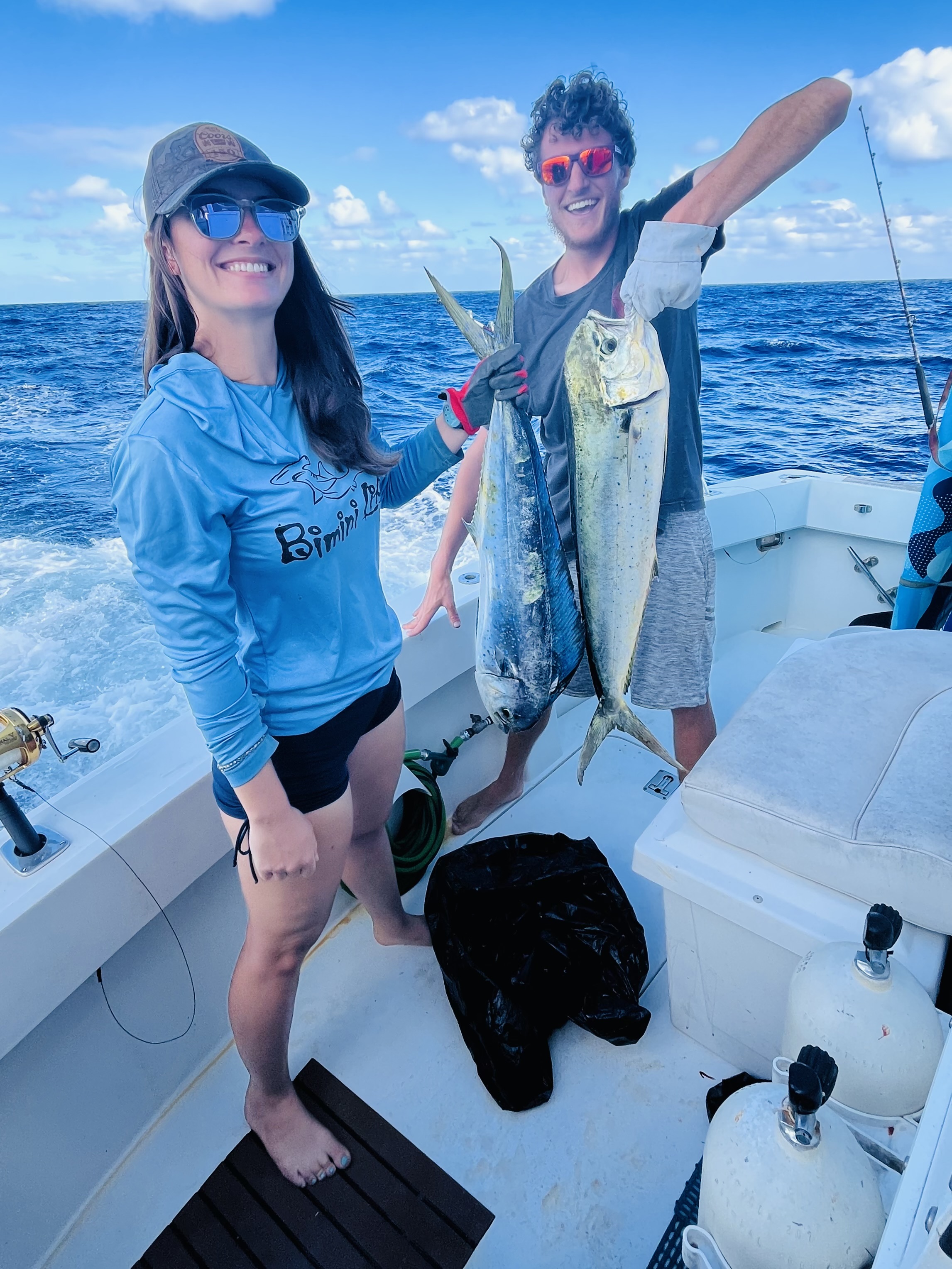
Two out of three isn’t bad
I was briefly sad about losing the big one, but the worst part is that we lost a really good lure along with our dinner. However there was no time to be upset, so we secured the two mahi in the back of the boat and redeployed the rods. The two we caught in Bimini didn’t last long with four people to feed and neither will these. There’s lots of room in our freezer that needs to be filled.
My dad went upstairs and got us moving again and then returned to fix the broken line. The only lure that didn’t get hit during the commotion was the deep diver so we changed it out for another squid. Might as well pull what seems to be working the best right? In hopes of getting to yell “FISH ON” I stayed in the cockpit ready for action. Again the time seemed to fly by without an interest in our baits, I guess I didn’t have the magic touch.
Slowly I became discouraged and decided to change it up again. Jules and I headed back upstairs to drive and left my parents on guard. By this time we were about an hour and a half from Georgetown and the sun’s rays had intensified greatly. Jules and I swapped off sitting in the captain’s chair, now deemed the “hot-seat”, trying not to get roasted alive.
After about thirty minutes my dad decided to take our places at the helm. As soon as he left the cockpit and left my mom alone another rod went off. Again she screamed “FISH ON!” I slowed the boat down to an idle and went to check it out. By that time Jules and my dad had both joined her in the cockpit and she was reeling her butt off.
Jules began reeling in one of the other rods to get it out of the way, my dad relieved my mom before her arm couldn’t take it anymore, and I ran back upstairs to stop the boat. We like to leave the engines idling briefly when the fish first hits the line so the momentum of the boat can help set the hook; and it also keeps the other lures moving in case there’s multiple fish ready to strike.
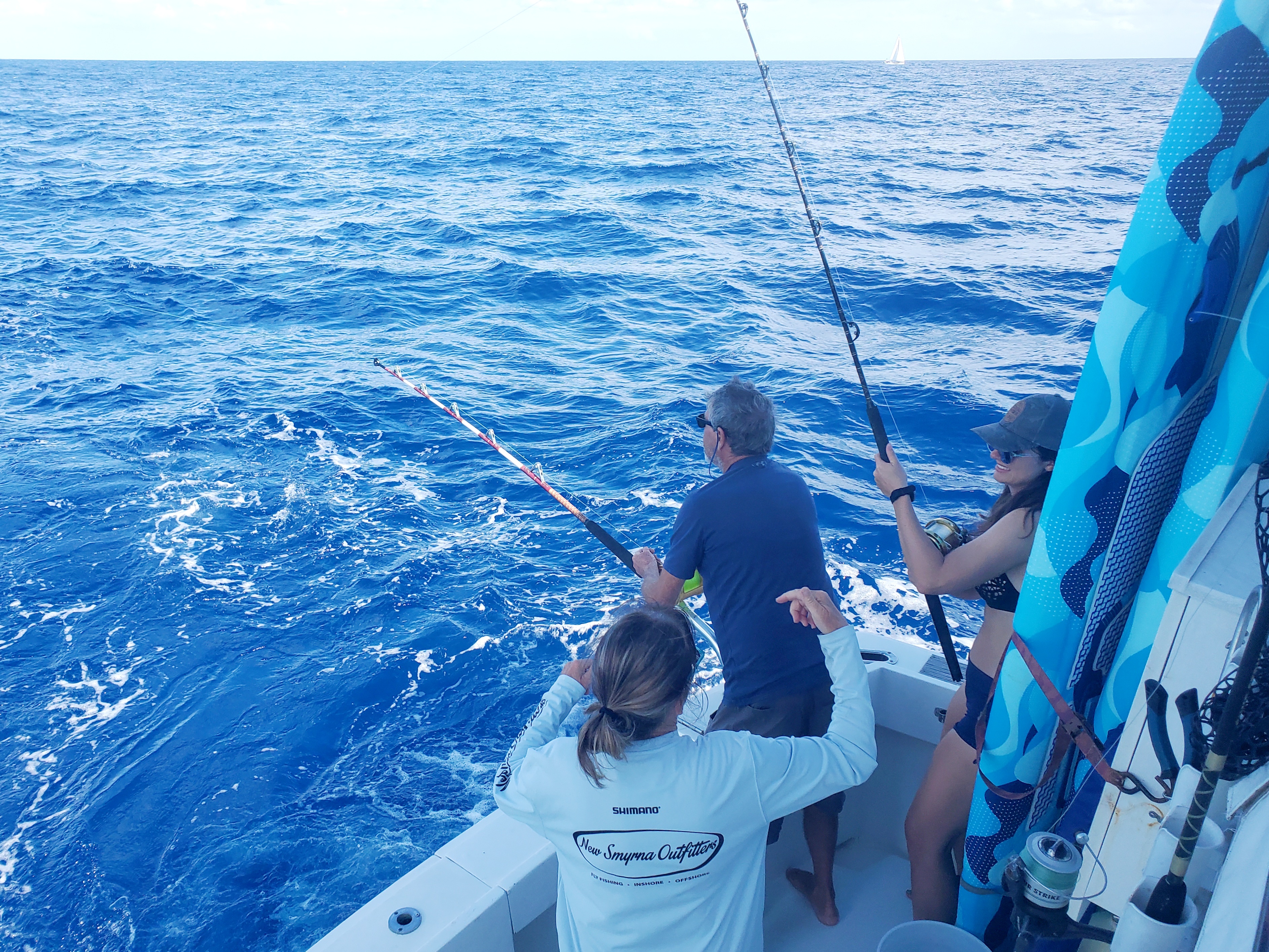
Absolute chaos in the cockpit
Once I had stopped the boat I ran back to help. I traded places with my dad as he brought the fish in close and he got ready with the gaff. It was a wahoo! I was scared to bring the fish too far out of the water as I did with our mahi-mahi near Cambridge, so I removed the rod from the holder to gain more control over the fish. It also allowed me to swing the tip closer to the boat to make the fish easier to gaff. Wahoo are long and slender which makes landing a shot all that much more difficult.
My dad leaned out as I brought the fish in close. The first two attempts were a swing and a miss, but I managed to keep the fish from throwing the hook. Third time’s the charm: the gaff landed in the belly of the fish and my dad hoisted it aboard. It was definitely larger than any fish we have caught so far, but calling it a monster would be a stretch. It’s the perfect size to eat if you ask me. There’s certainly going to be less room in our freezer now.
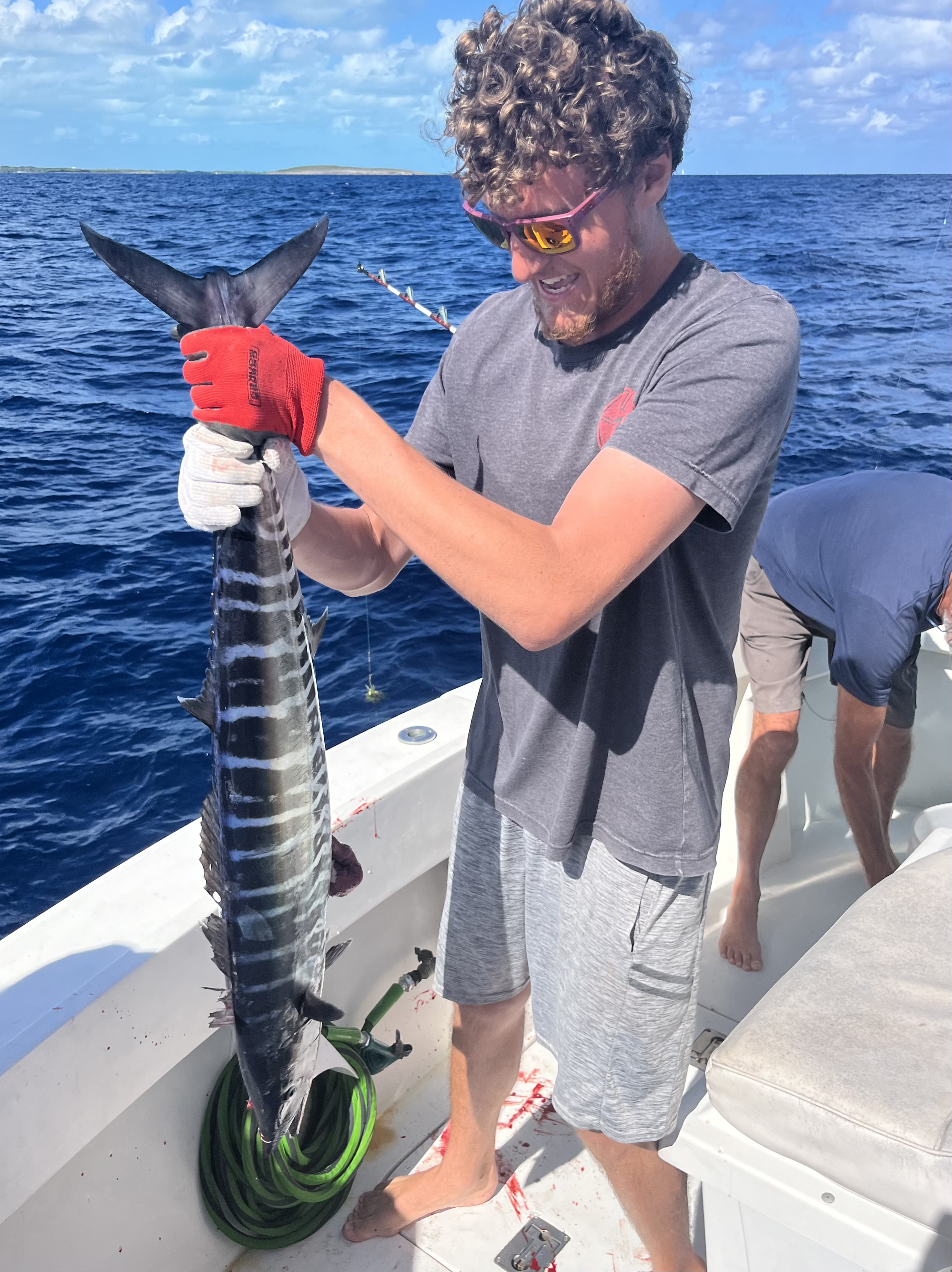
Jules has been dying for wahoo since we got on the boat, her wish finally came true!
The fish was dispatched quickly by its wound and we got the rods back in the water hoping to get lucky one more time. By then we didn’t have far to go before we turned into Elizabeth Harbor to anchor near George Town. We drug the lures until the last possible second but didn’t end up adding to our haul. We reeled the rods in and my dad joined me in the cockpit to clean our catch. Recently, he was able to put a sharper edge on the filet knife and what a difference it made. He made quick work of the two mahi-mahi and I started rinsing and cleaning the meat to get it ready for packaging.
Once we parked in Elizabeth Harbour, I sent the first two fish inside for my mom to bag and vacuum seal before freezing and my dad started working on the wahoo. The first half of butchering was easy, but removing the skin from the meat turned into a back-breaking process. The mahi-mahi skin is tough and the knife easily slides between it and the filets; but the wahoo is much more delicate and makes it difficult to cleanly separate the flesh from the silvery skin.
By this time our mouths were watering at the thought of our fresh catch. After what felt like an eternity for my dad’s back he finally finished. I have been studying the process and Jules is eager to learn so maybe next time she and I can take some of the load off of his shoulders. It would help tremendously if we could stand rather than kneel when cleaning fish, but the fish are always too long to fit a normal cutting board so the floor is the easiest place. I guess we shouldn’t complain about catching big fish.
I went ahead and cut filets out of the skinned wahoo, rinsing it before handing it to my mom to package. My dad and I then got to work rinsing the crime scene out of the aft deck. He and I both snagged a scrub brush and went to town. Every time we thought we were almost done we would spot more blood, scales, and slime. If any of it is left behind it won’t take long before the smell lets us know. Jules then took the liberty of slicing some sashimi out of the wahoo. Her hunger for the elusive fish had finally been satiated. She brought out Wasabi, soy sauce, and ginger and we made quick work of the fresh fish.
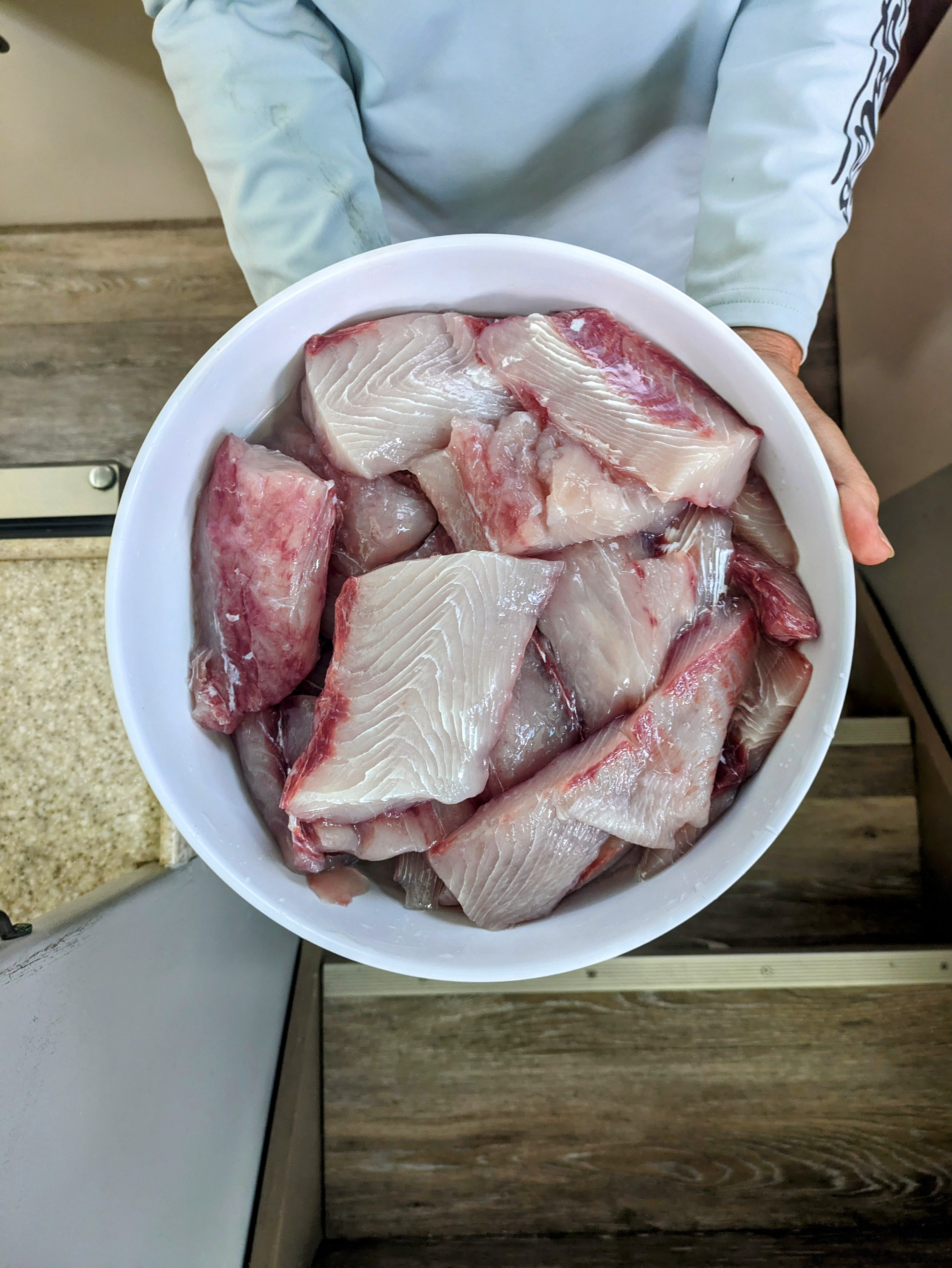
The results of a good day fishing
Once we were satisfied and the fish had been fully taken care of it was time to go grocery shopping. George Town is by far the largest portion of civilization we have stopped at since Florida. We did spend a night parked at Nassau, but the next morning we were back on the move and never went ashore so this was the first city we had stepped in since Key Biscayne.
I helped my dad lower the skiff and we loaded it up with a rolling cooler, backpacks, a gas can, and our trash. Our shoes also made an appearance for the first time since Blackpoint. The skiff ride across Elizabeth Harbor from the northeastern anchorage was a fairly long one; luckily the wind was calm and the waves were fairly minimal. We headed southwest across the harbor, past a large group of anchored boats, and passed under a tiny bridge into Lake Victoria. It’s not a traditional lake but rather a small, well-protected bay with free docks to park at and run errands.
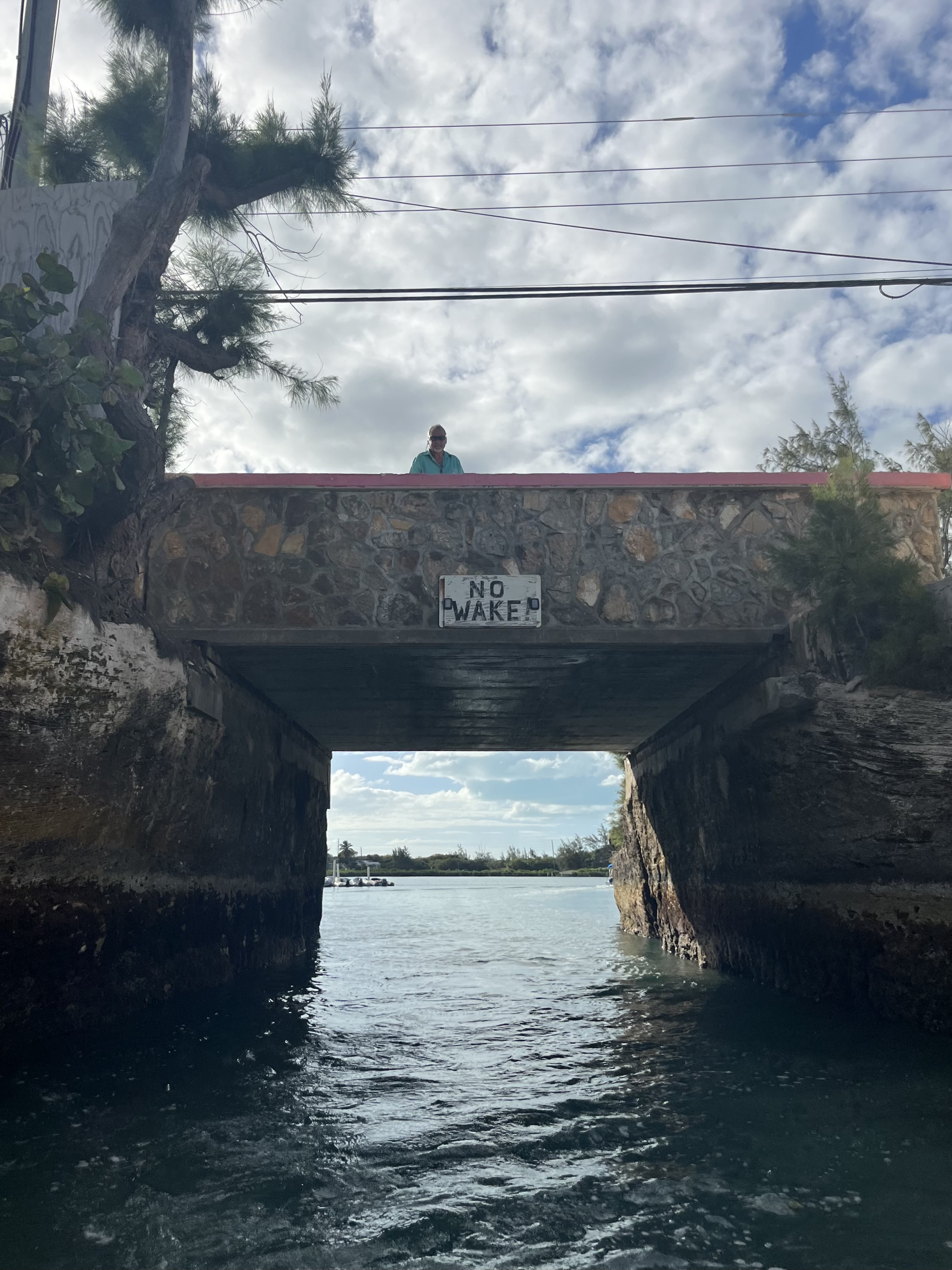
The narrow passage into Lake Victoria
We pulled into the first dock on the left and joined a multitude of other skiffs. I hopped out, tied us up, and began unloading our bags. I carried our trash up a short hill and was directed by my parents to a truck parked in the lot. Similar to Blackpoint, it was all on the honor system. The front window of the truck was cracked just slightly and there was a piece of paper stuck inside with rates for disposal written on it. Large bags were five dollars, small were four, and they would even dispose of used oil for a small fee. I pitched our bag into the back and slipped four bucks in through the slot.
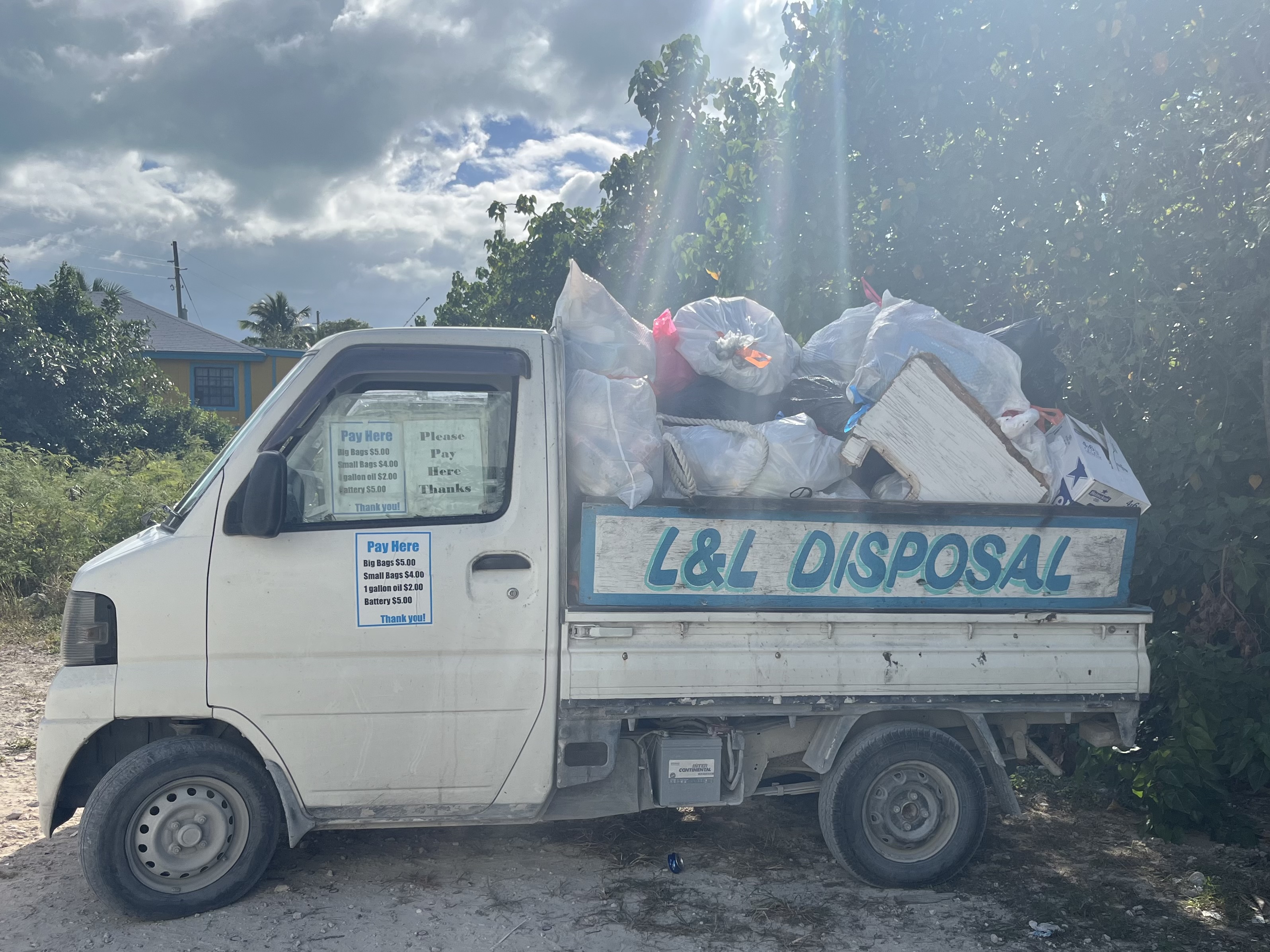
Talk about passive income
Our next stop was of massive importance: the liquor store. Jules and I were very nearly out of rum! We picked up five bottles of Ricardo for seventy five dollars. Fifteen bucks a piece is definitely the cheapest we’ve seen since Bimini. The grocery store here is large enough that they actually have carts. Their vegetable selection wasn’t phenomenal as it had been fairly picked over, but it far surpassed Staniel Cay or Blackpoint. The store was actually fairly close in size to a small King Soopers, just more expensive. Jules did find ramen for seventy nine cents a piece though.
By the time we were ready to check out, we had just about every item on our list. Our cart was fairly full and the total was two-hundred and forty dollars. I was honestly expecting it to be much higher. I’ve spent far more than that on groceries in Denver. We then loaded up our tote bags and took a short walk back to the dinghy dock.
Our final errand was to fill up the gas can for our skiff. We untied, turned around, and went about fifty feet over to a different dock behind the gas station. There were a few people waiting that told us the tanker truck was filling the bulk tanks. I think they may have gotten distracted talking to one another as my dad strolled right past them up the hill and returned promptly with a full can of gas.
Now we had to get our haul across Elizabeth Harbor and put it away. There was so much weight in the skiff that it wouldn’t even get up on the plane even though my dad had the throttle cranked. It was like we had a lead brick laying on the floor between us. Finally, we arrived back at the Altitude Adjustment and promptly stowed the fruits of our labor.
Apparently we picked today to be gluttons for punishment and headed out one last time for a nearby beach to take a walk before sunset. My dad drove us through the vast array of anchored boats and we landed on some beautiful soft sand. We leisurely strolled through the knee-deep water and reminisced about our wildly fortunate day of fishing.
My dad spotted a massive red cushion sea star a few feet offshore in the clear water. They are the largest species of sea star found in the Caribbean and can also be colored yellow, brown, or green, depending on their life stage and diet. We all stood over the huge omnivore and admired the crazy pattern on its skin.
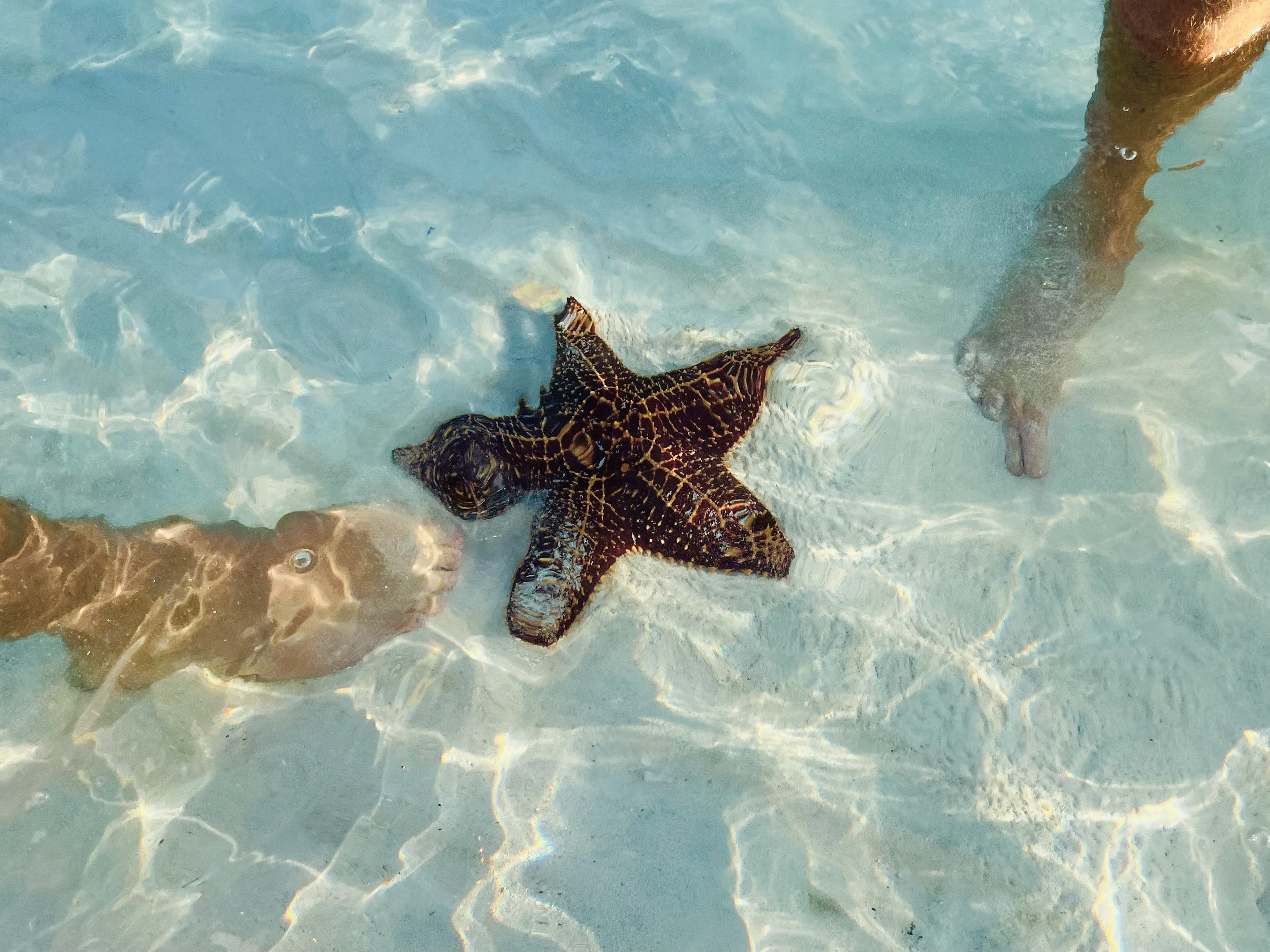
Don’t mind my distorted alien toes
We meandered out to the point basking in the dying sunlight and taking in the great view of Elizabeth Harbor. Jules and I cautiously took a seat on a makeshift swing set built on the beach, but rapidly lost faith in its ability to hold us upon seeing the rusty connections. Around that time the sun was nearing the horizon and we headed back to the Altitude Adjustment. Cocktails needed refreshing and fresh fish tacos were on the brain as a celebration for our long successful day of traveling.
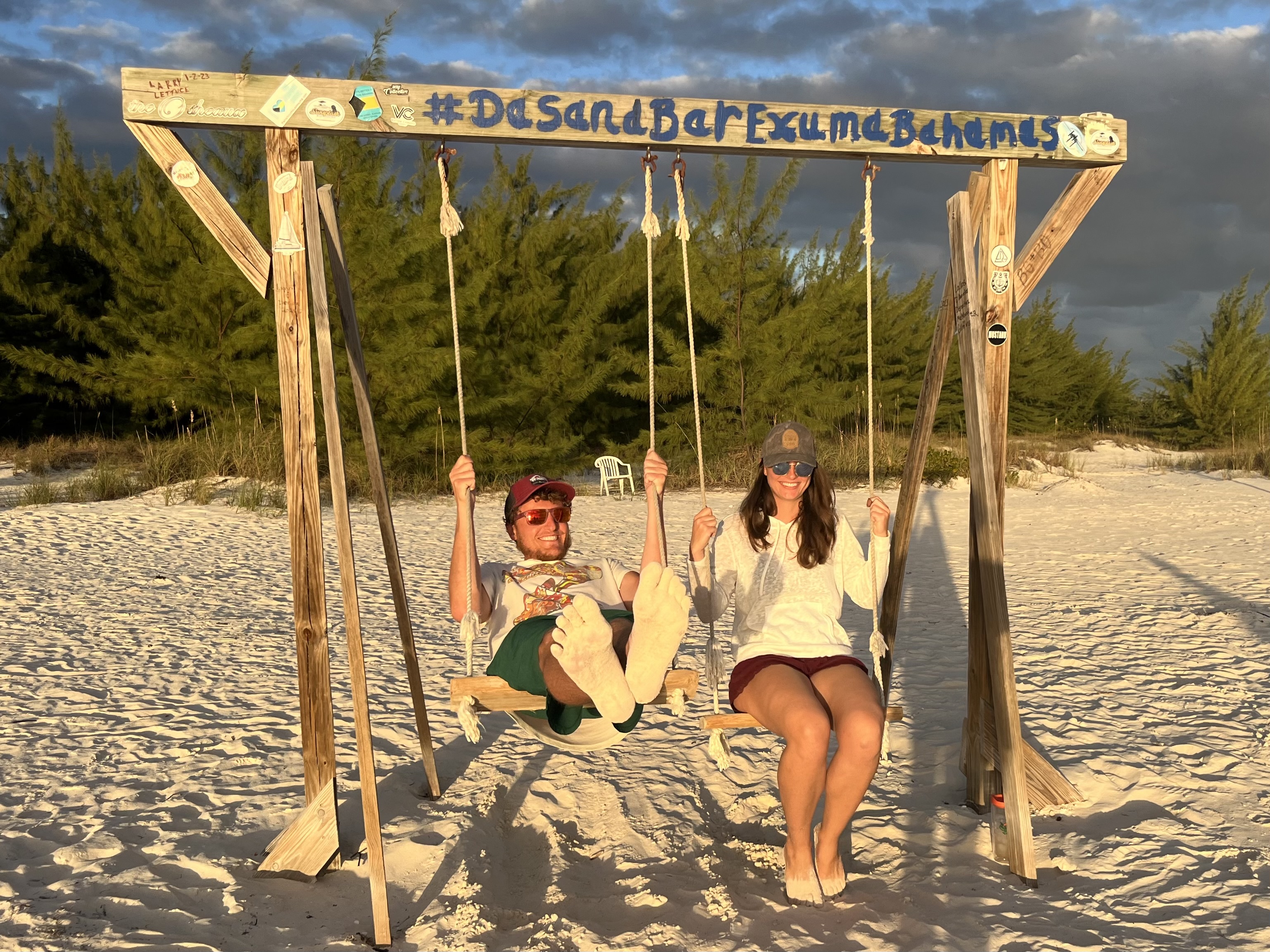
So glad we didn’t break anything
Jan 31, 2024
There is some really gnarly west wind on the forecast for this upcoming Tuesday. Luckily, Great Exuma Island has quite a few spots to hide. There is an area just south of George Town that is called Red Shanks where my parents anchored on their first trip. They told Jules and I that it has fantastic protection from the west so we hauled up the anchor and headed that way right after we woke up.
On the way there we got introduced to the George Town cruiser net. There is such a large and consistent population of boaters in the area that someone started a daily radio chat around it. There is one person that is the moderator and he prompts the questions and calls on each boat so that the channel doesn’t dissolve into chaos with the multitude of people trying to talk at the same time.
They start each day by reading the weather and tide reports before calling on new arrivals to introduce themselves and their crew. There is no requirement to participate but there’s no harm in saying hello either so my dad went ahead and announced us. After welcoming all of the incoming boats they run through all sorts of community activities. There’s a segment for trading, selling, and buying hard-to-procure items, information surrounding the local farmers market, volleyball practice, yoga, a weekly Texas Hold ‘em tournament, local knowledge, a “Kids Corner” which is mostly kids telling jokes, and they end it with a daily inspiration.
There are many boaters that spend their entire winter here in Elizabeth Harbor and the cruiser net is a great way for them to stay connected with one another. We are only planning on staying for a week or so to get through the nasty upcoming wind, but I can see why it’s a popular destination. My dad heard that the Red Shanks’ anchorage had been filled up with mooring balls and they even mentioned how many were vacant as we cruised over. Someone also informed the group that the moorings are free until the middle of the month.
I figured the entire field would be packed with the upcoming weather and no nightly fees, but when we arrived there were surprisingly plenty of spots to choose from. We picked out a prime mooring ball nestled between the western and eastern ironshores that should be ideal protection. By the time we got hooked up the weather couldn’t have been much more beautiful; the sun was completely unimpeded by clouds and barely a breath of wind graced our presence.
Seeing as how we are going to be here for a good chunk of time, I have been scrutinizing our charts and picking out things we would like to see in the area. Red Shanks happens to have a blue hole in very close proximity to it as well as some snorkel spots that seem promising. We lowered the skiff and headed to try and locate the blue hole. According to our map it is just outside the channel of water that people use to get to town with their skiffs. Overall I think it’s only a minute or two away from the Altitude Adjustment.
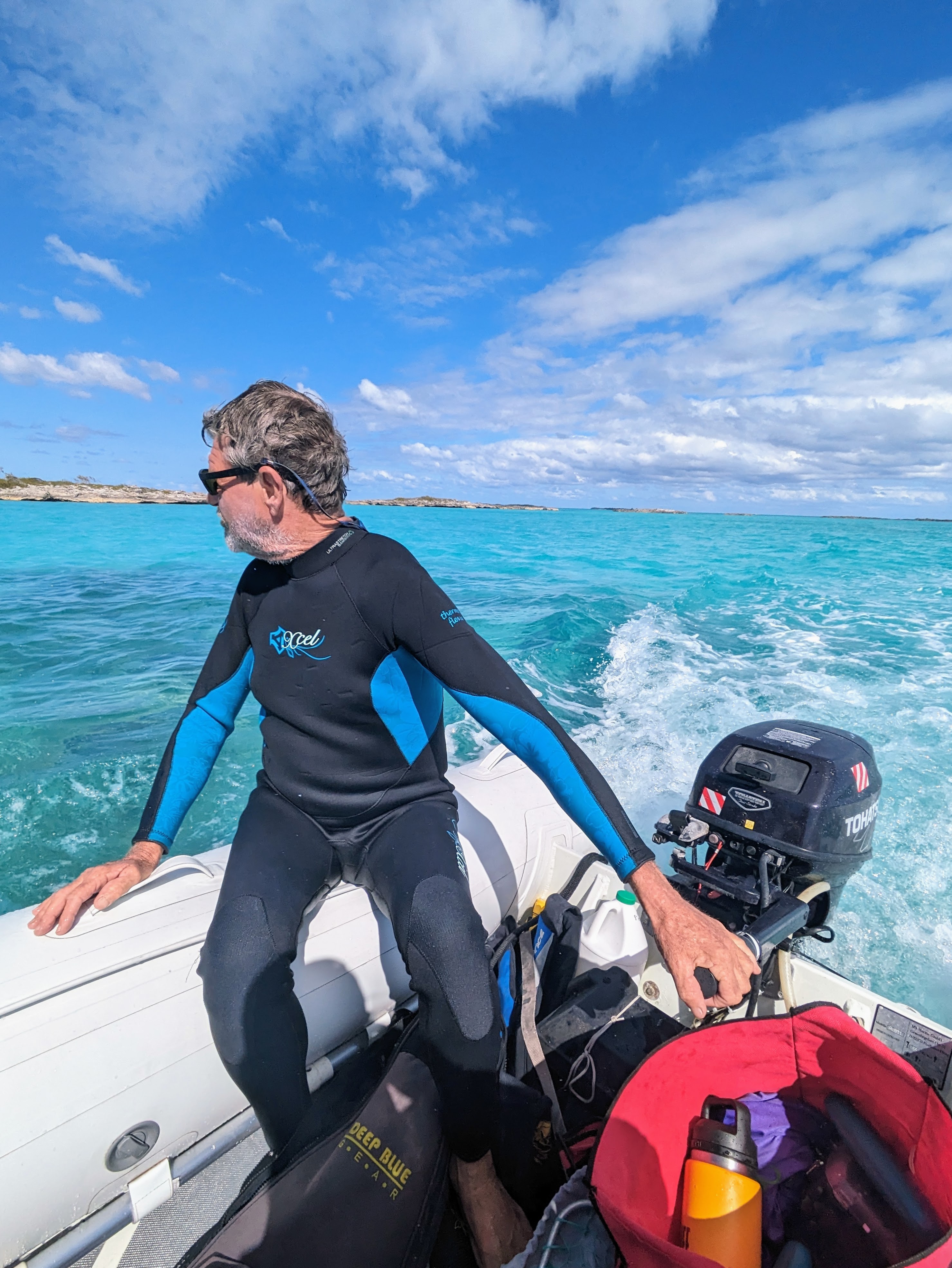
Searching for the blue hole
My dad drove us into the general area we had picked out and we started looking; unfortunately the water in the channel wasn’t as clear as we would have liked. We passed over the darkest blue water we could see and used our handheld depth gauge. The water was only about fifteen feet deep. Blue holes are underwater sinkholes that can reach depths of up to nearly one thousand feet. This one wasn’t anywhere near that depth, but maybe it is just starting to form.
Since it is located in the middle of a semi-busy waterway and the water was murky we decided to head elsewhere to try and find something more interesting. There is a set of rocks that marks the entrance to Red Shanks and our charts show coral all around them so we went to investigate. By the time we dropped the skiff anchor and got masks and fins on I was sweating profusely inside my all-black wetsuit.
I was dying to get in the water. I jumped in and swam around briefly to check on the current. The first thing that I noticed is that the water was far colder than anywhere else we had been. There have been a few times when I questioned if I even needed a wetsuit; this was certainly not one of those times. My parents and Jules joined me in the water and were all equally as surprised by the temperature.
My next observation, which I believe was also shared by the whole group, was that the visibility sucked. From above it appeared to be clear and beautiful like we have grown accustomed to, but under the surface the sand was stirred up tremendously. Not only was it suspended in the water column, but it also formed a thick layer on top of many of the coral heads and sea fans. It seemed to be choking them out and killing them.
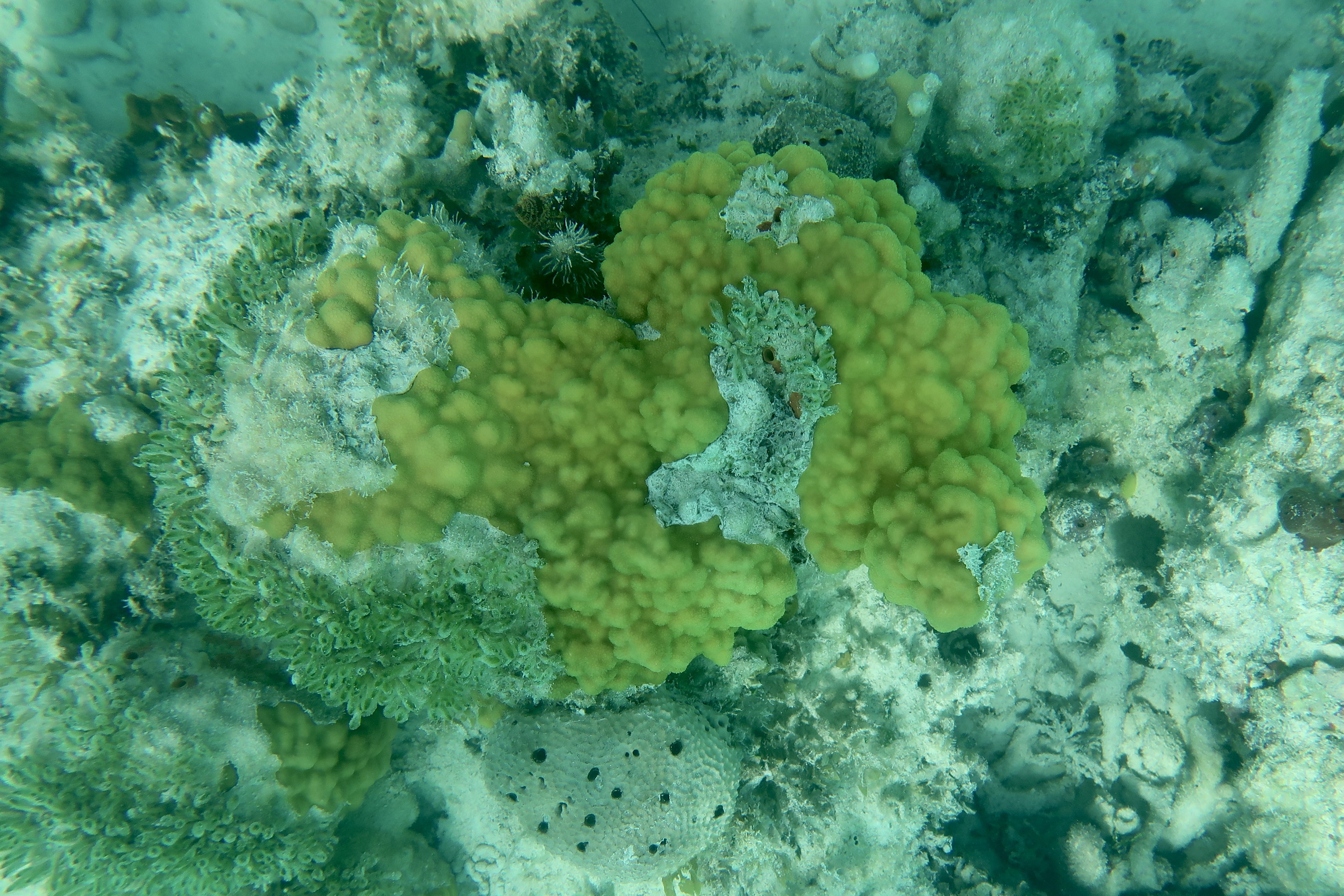
Coral struggling under layers of settling sand
I’m not sure what exactly was happening because the fine sand in the area must get suspended frequently and obviously the coral was able to grow in the first place. It would make sense that the corals would be adapted to handle the sand and remove it from its exoskeletons, otherwise they would have died out of the ecosystem long ago.
It had a similar look to it as stony coral tissue loss disease which is highly lethal to over twenty species of coral and is found throughout the Caribbean. It was first recorded off the coast of Florida in 2014 and spreads over coral reefs faster than covid spread across the United States. I’m not positive that the disease is what we were seeing, but I wouldn’t be surprised.
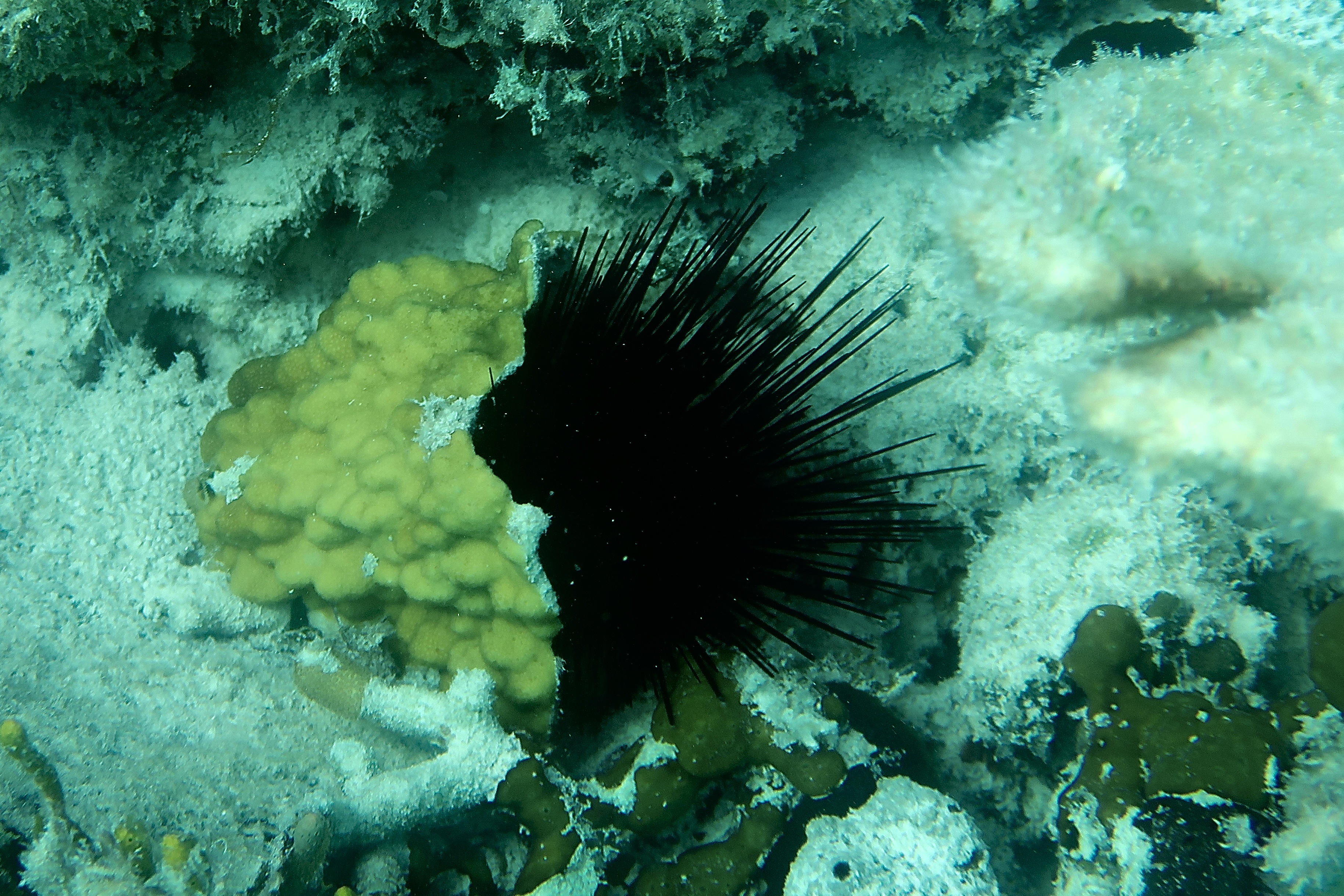
A massive sea urchin nestled in the reef
Unfortunately when the reef is struggling like that, it also makes life harder for the fish and other invertebrates that inhabit the area. We swam around the rocks and were somewhat unimpressed by the area. There were plenty of damselfish and sergeant majors as well as the usual snappers and grunts, but many of the reef fish I’m used to seeing weren’t present. There were no lobsters or turtles either, but we did see a massive red cushion sea star laying on the sand between some rocks.
It wasn’t long before the chilly water got the best of us and we returned to the skiff. I didn’t notice it in the water, but once I got out I realized my fingers and toes had started to go numb. Jules said hers felt the same way, but my parents thought we were just being dramatic. We cruised back toward the Altitude Adjustment while trying to absorb as much sun as we could.
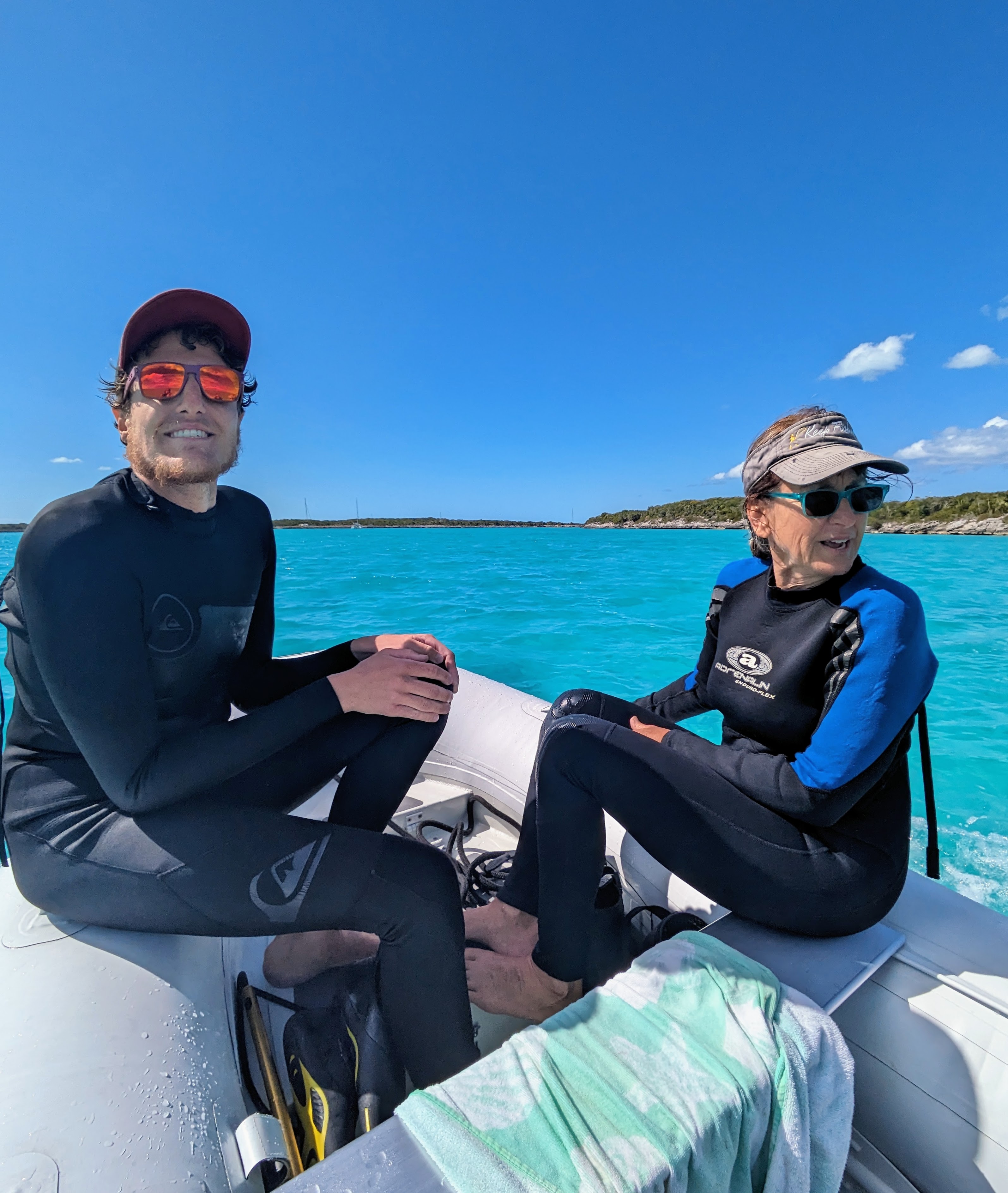
Doing our best to photosynthesize
Once we got back, my dad decided to do some maintenance under the boat while he already had his wetsuit on. He wanted to investigate a rattling sound we’ve heard since leaving Georgia. The prop shafts under the boat are fitted with a set of rotating knives that function as rope cutters; this prevents lines from potentially fouling the props. There are also some rubber bushings that act as sound dampeners and my dad thought that these may need to be replaced.
For the first time this trip we broke out some dive gear and a tank. He flopped into the water with the cumbersome equipment and removed the parts. I took them and replaced the old crusty rubber before handing it back to him to reinstall. I think it took longer for him to get all of the gear ready than it did to do the actual repair but hopefully the incessant rattle has been taken care of.
By the time we finished up I looked around and noticed that the mooring field had filled up completely. Looks like we had some good timing. Initially we thought about spending an extra day at Rudder Cut Cay, but I think we are all happy to have headed south instead. We would have arrived late this afternoon and been scrambling to find a good spot to avoid the upcoming west winds. Instead we got here with plenty of time and now we can relax and wait it out without any stress.
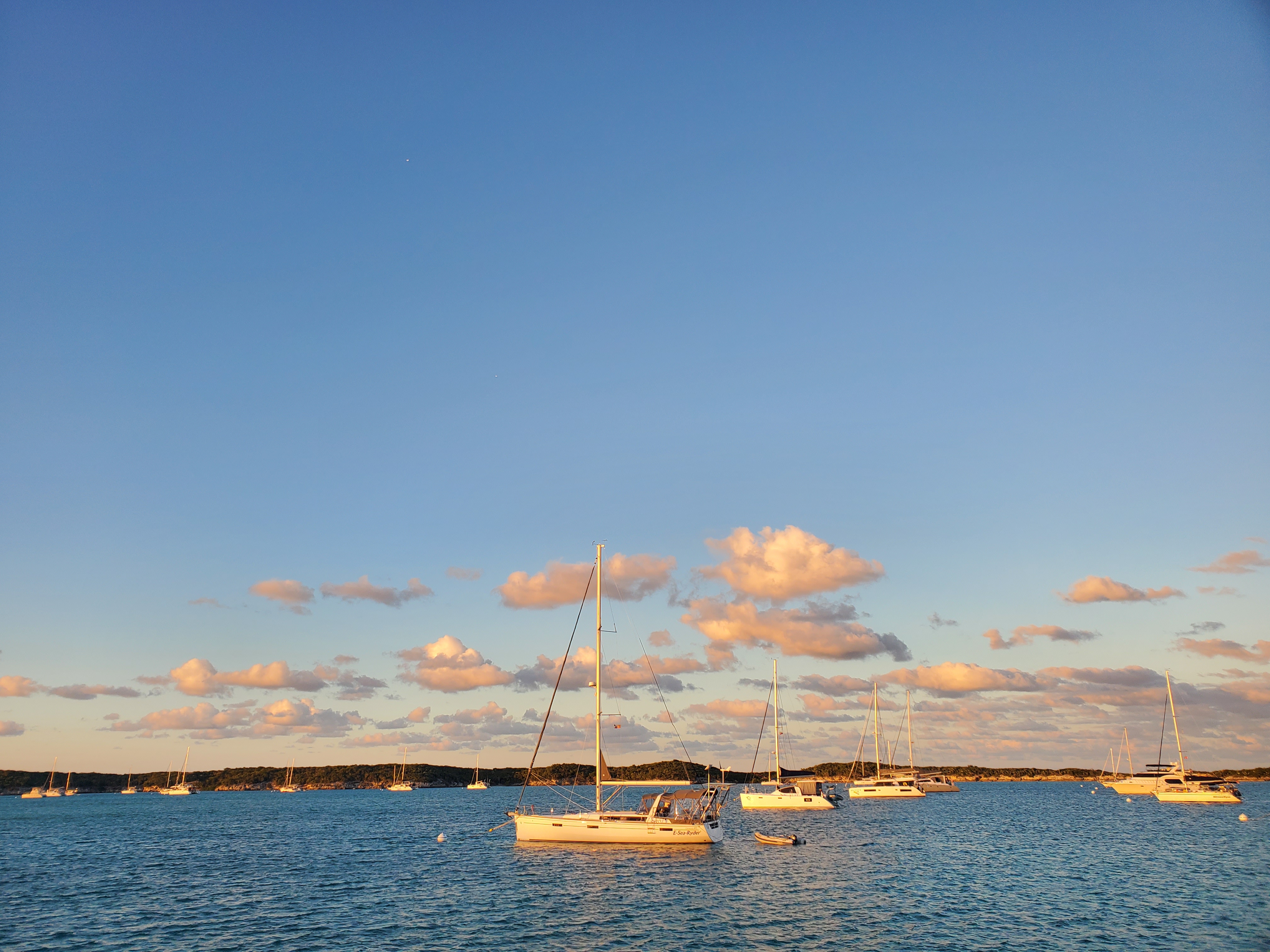
Our home for the foreseable future
Jules and I used the remaining sunlight to warm up on the bow and, after watching another killer sunset, my dad grilled up some blackened mahi-mahi while my mom made her signature cream sauce filled with veggies and served it over pasta. It’s much more fun to ask the question “how are we cooking the fish tonight?” Rather than debating about what protein to defrost.
Feb 1, 2024
For the first time in a long time, Jules and I broke out the big comforter this morning. We really enjoy sleeping with the big hatch over our heads open for the airflow, but this morning our nice gentle breeze got very chilly. So chilly in fact that I put on my long pajamas and didn’t take them off until almost noon.
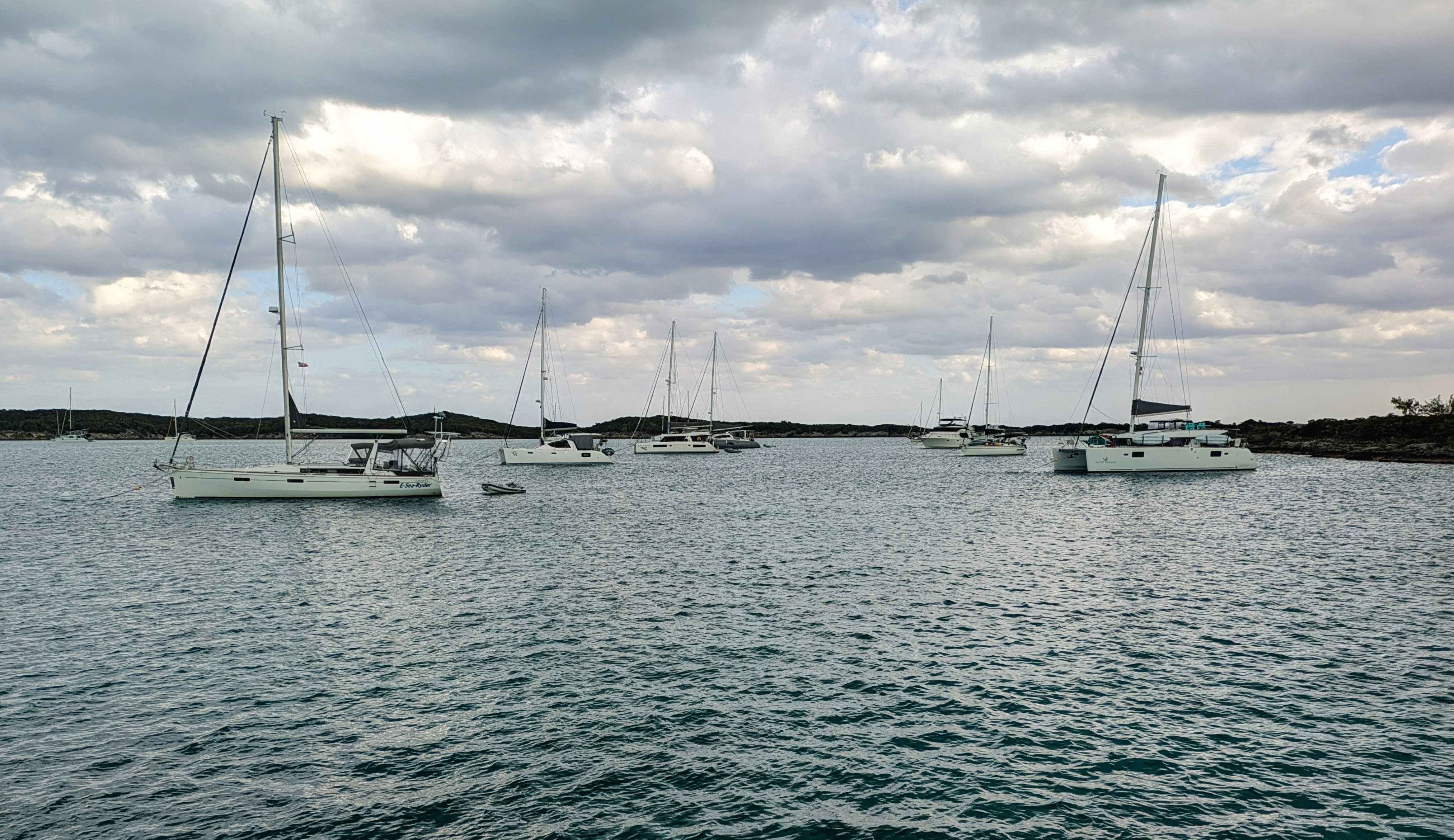
A steely gray morning at Red Shanks
Jules took the morning to continue planning for her friend Amanda’s arrival in March. Trying to predict where we will be in a month and a half is nearly impossible as the weather dictates our every move. Jules has been researching airports like a mad woman trying to nail down a few different options for Amanda to fly into. Just like everything else in the Bahamas it’s much easier said than done.
Many of the small airports on these islands have strange names which makes them very difficult to find when searching on a travel site. When she searches “Eleuthera” on the website, it only shows one airport even though there are two others further south on the island. In hopes of making her friend’s travel more painless, she has taken it upon herself to wade through the ill-maintained travel sites. I guess if we ever decide to fly in for a vacation later on in life it will be good information to have.
My dad has been keeping a close eye on our diesel consumption and decided today it was time to transfer fuel. The Altitude Adjustment has four tanks that hold diesel and our engines are set to draw out of the largest one. So far we have burned around 300 of the 430 gallons it holds. Rather than waiting until it’s empty, there is a fuel transfer system on board that allows us to add the contents of the smaller tanks to the large one. If you haven’t ever run out of fuel in a diesel engine consider yourself lucky because getting it restarted is a nearly insurmountable task. Naturally, we would like to avoid that at all costs.
My dad went ahead and showed Jules and I the process of setting valves and running the pump to add 240 gallons from our aft fuel tank into the midship tank. The whole system reminded me of the valves and pumps I operated while working at Coors, just on a very miniaturized scale. The whole transfer took roughly two and a half hours at one hundred gallons per hour. Unlike some of the operations on this boat, it performed flawlessly.
Once we had topped off the main tank, we were all ready to touch some solid ground so we took a short skiff ride to a nearby beach for an afternoon walk. Something that has surprised me for nearly this entire trip is the lack of shells. I am usually quite the collector and in the past I have been very fortunate to find some killer shells, but so far I don’t think I have found a single one that I brought back to keep. I have picked up a few small ones that I gave to Jules or my mom, but nothing substantial.
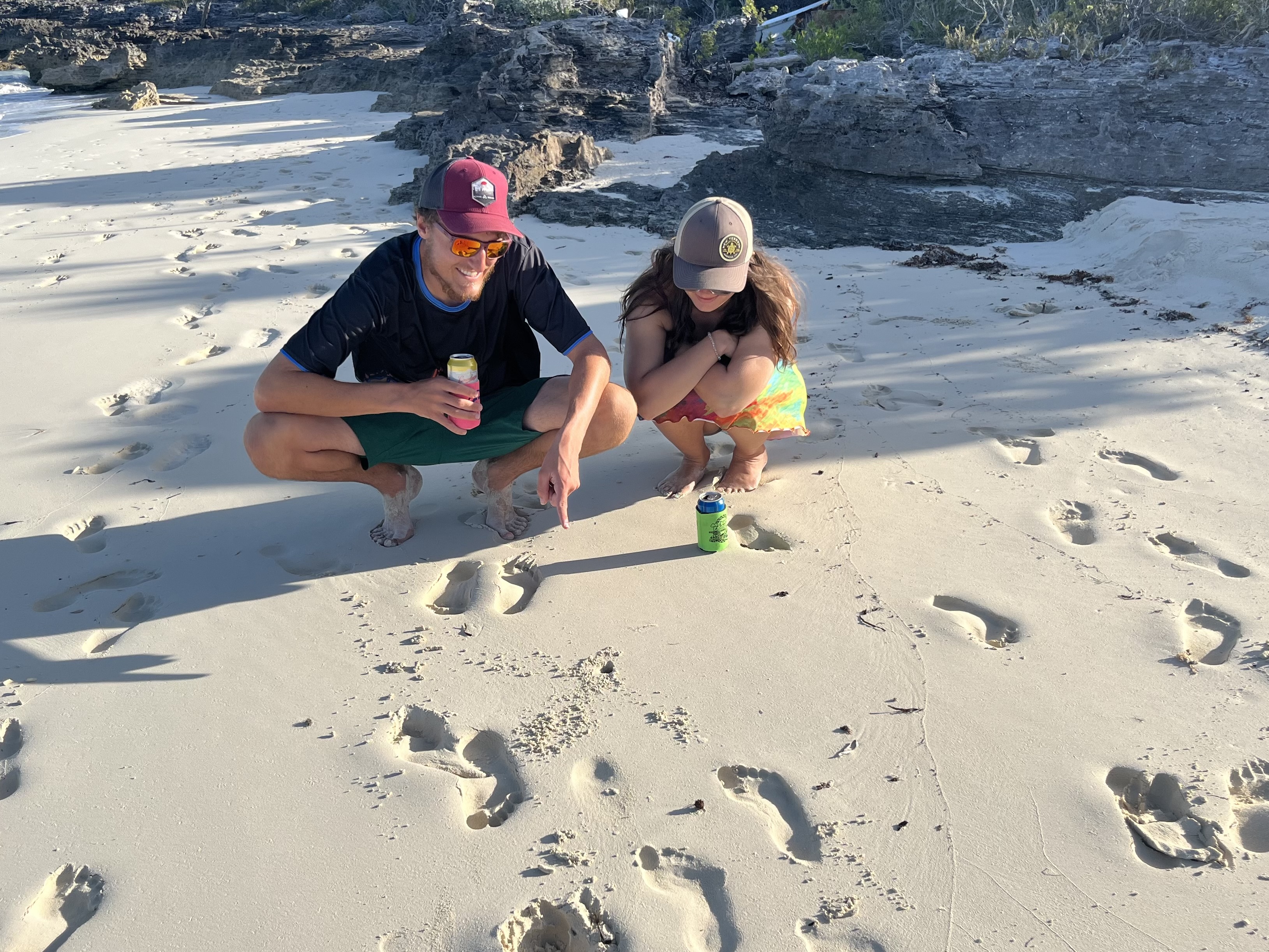
Jules saw a tiny crab inside a hole in the sand and we were waiting to see if it would come out, it didn’t
We walked from one end to the other of the soft silky sand beach and once again I returned home empty handed. The wind chill continued into the evening and reluctantly I brought out my pajamas again. The temperature never dipped below sixty five, but with the humid air and wind blowing, shorts and a t-shirt were far from sufficient. Everything is ten degrees cooler on the water.
Feb 2, 2024
Silence filled the morning air when we woke up. Not a single wave lapped on the hull and the wind generators on the neighboring boats were at a standstill. My parents jumped on the paddleboards immediately and took off to explore. Jules and I hung out on the boat and ate some breakfast awaiting their return.
The water and wind were so calm that people were out on their boards in full force. It seems like everyone in the mooring field had the same idea. Eventually my parents returned from their long expedition and Jules and I happily took their place.
The ripples on top of the water were almost nonexistent and made it much easier to see down to the bottom. My parents told Jules and I that they saw multiple huge starfish and that the far wall of the cove had some cool caves we should check out. She and I headed out and followed a similar route to theirs. It wasn’t long after we left that we began seeing the aforementioned starfish.
I also noticed what I thought were some strange plants scattered across the sandbed. As we paddled along the shoreline I finally got a closer look at one of them and realized that they weren’t plants after all, but upside-down jellyfish. Their true name is Cassiopea and they’re found in shallow warm coastal regions all around the world. The last time I saw one was on a class trip to Belize, but there weren’t nearly as many. They aren’t immobile, but remain largely stationary while laying on the sandy bottom looking very similar to the nearby aquatic plant life.
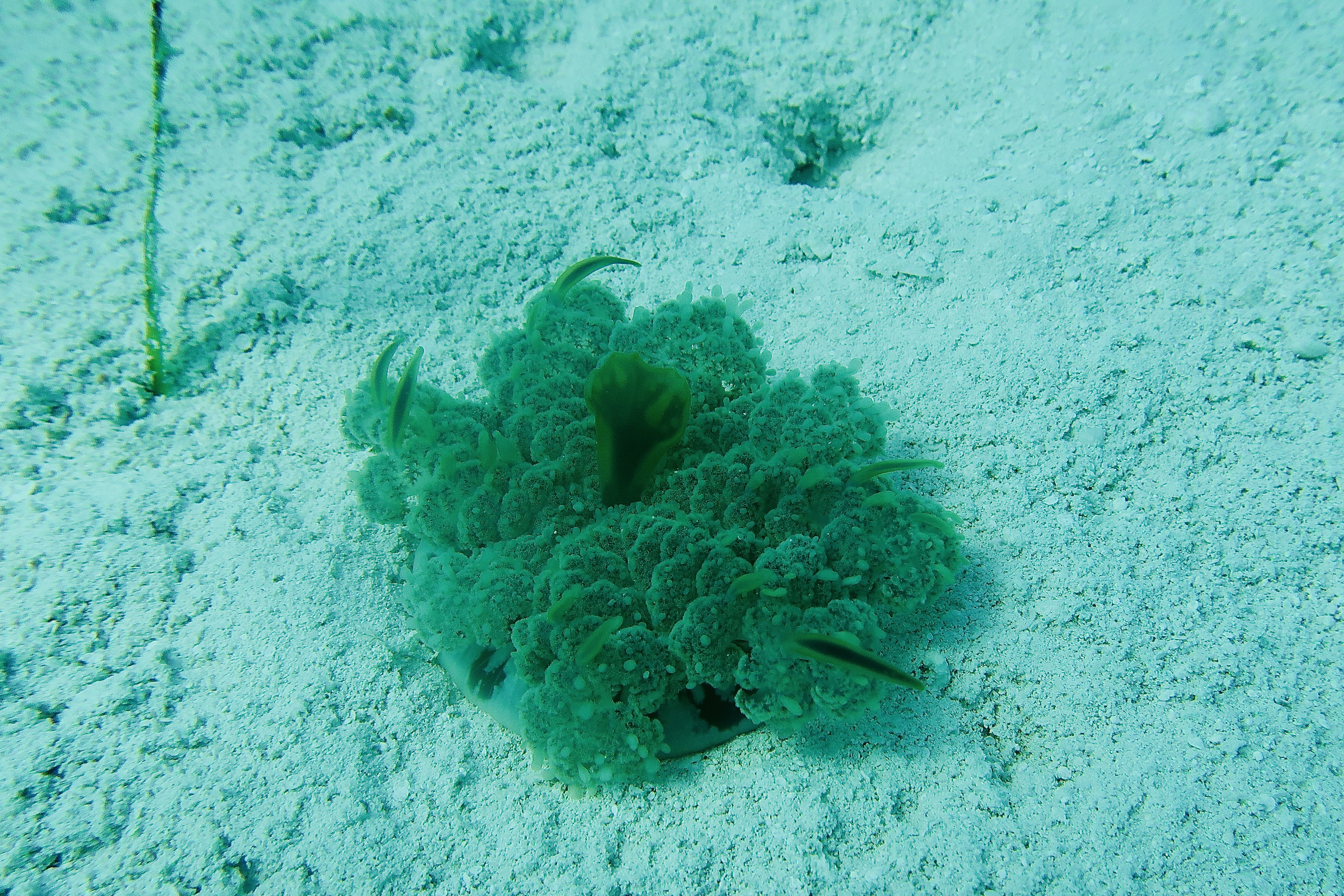
Cassiopea tentacles swaying softly in the current
Like coral and many species of clams they have a symbiosis with zooxanthellae (pronounced “zoo-zan-thell-ee”) algae that lives within their tissues. They live in shallow, clear water so that the algae can photosynthesize and then utilize the sugars and starches produced as a food source. In turn, the algae is provided with a well-protected habitat to live.
There are nearly three thousand species of zooxanthellae spread between freshwater and marine environments, and the distribution of photosynthetic individuals harbored within each host varies widely. The variety of algae living inside a jellyfish produces a color combination that is unique to each organism which is also true for many clams and corals.
These microscopic algae are the true unsung heroes of marine environments and make life for coral reefs and many other host species possible. When they vacate their host it almost always results in death for the organism. Coral bleaching events are a product of zooxanthellae evacuating due to unsuitable living conditions such as high water temperatures or ocean acidification. Super long story short, they’re incredibly important!
Jules and I startled a couple of very small turtles that were hiding along the cracks in the ironshore. It was tough to get a good look at either of them as they thoroughly dismantled the stereotype of turtles being slow. Seriously, they were flying through the water away from us. She and I rounded a corner and passed right in front of the beach we walked down yesterday.
There is a wall of ironshore here that is decorated with all manner of conch shells. Many of them have been painted with names of people on them. They are stowed in small nooks in the wall and suspended in the trees surrounding it. We don’t know the significance of them, but it appears to be some sort of tradition among cruisers down here.
Shortly after passing the conch display, I looked to my left and saw a large dark shadow under the surface. I called out to Jules letting her know that I thought there was a big nurse shark passing by us. Interested to get a better look, I turned around and started following it. It turned into some shallow water against a tiny spot of sand and gave Jules and I time to catch up before turning around straight toward us.
At that moment the sun caught the side of the shark perfectly illuminating some very well-defined vertical stripes. Nurse sharks don’t have vertical stripes, but tiger sharks sure do. The pattern was unmistakable and I nervously commented to Jules what I had observed. She gave me a look of sheer disbelief thinking that obviously I had made a mistake.
She and I were both standing on our boards floating about eight feet apart and the shark swam right in between us. Jules then recognized what I was talking about and a brief moment of trepidation enveloped us both. The shark was easily as long as our paddleboards and took its sweet time to size up Jules as it swam by. They briefly made eye-contact as it approached the surface. My only thought was “please don’t bump into one of the boards”. It wouldn’t have taken much persuasion and either one of us could have been in the water with it.
I would consider myself comfortable around the vast majority of marine animals, but tiger sharks are one of the most apex predators found in the ocean. People swim in close proximity to them on a regular basis without incident, but they are also one of the three species of sharks that are known to occasionally attack people. Now on average about four times more people drown per year than are attacked by sharks, but I think we’re all a little traumatized after seeing Jaws.
The majority of attacks are a case of mistaken identity where someone is in the wrong place at the wrong time. Usually they occur in murky water where sharks are utilizing their sensory organs to hunt rather than sight. In our case, the water was crystal clear and I believe it was fairly obvious to the shark that we weren’t a normal menu item. All consternation aside, that was one of the coolest encounters either of us have ever had with a shark, and I would do it again in a second!
Once the two of us had calmed the butterflies in our stomachs, we continued on our exploration. The erosion along the wall generated some very precarious looking overhangs. There were multiple areas that appeared to be only a few grains of sand away from collapsing under the weight of rocks and trees supported on the thin shelf.
We turned around a corner at one point and the water became noticeably deeper beneath us. The bottom was like a huge funnel with the sides slowly tapering in toward a dark blue hole in the center. There was a multitude of fish surrounding it ranging from juveniles up to some large adult snapper. With this area’s predisposition for blue holes, my theory is that what we floated over is a very young one that could eventually descend hundreds of feet below the surface.
Eventually we returned to the boat and proceeded to squeeze every ounce of sunlight we could out of the day by lounging in the serene water. Again we were surprised at how much chillier the ocean is here than our previous stops. We have consistently moved south, so I assumed the water would gradually increase in temperature as we went. However with the Gulf Stream mixing warm and cool water as it runs north from the Gulf of Mexico, it’s hard to determine a consistent trend.
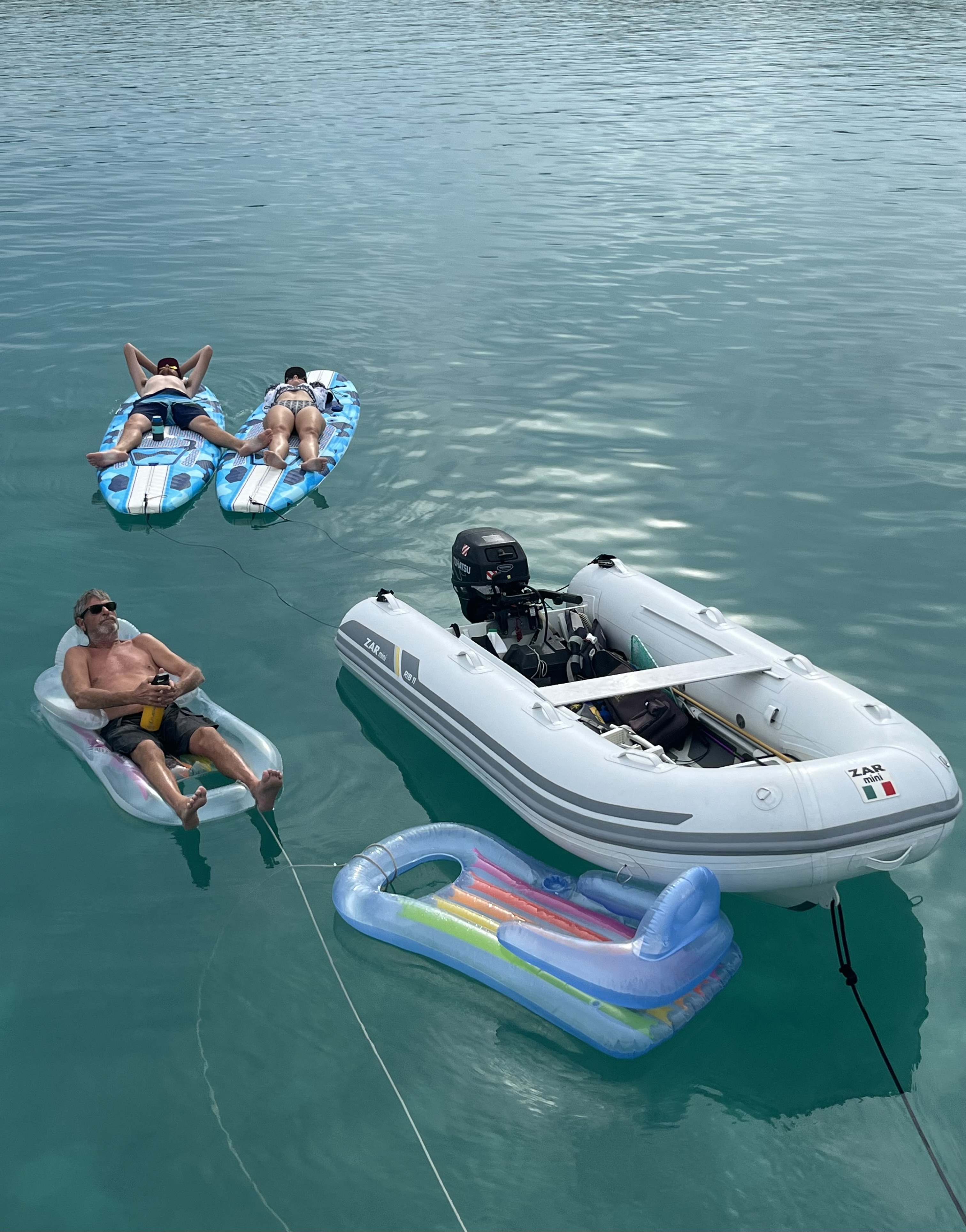
Life is so hard sometimes
Luckily the potent sunlight coupled with the absence of wind kept us plenty warm despite the bracing water. Eventually it was time to get out and start putting floaties away. Once we had them stowed I requested a haircut from my mom. She doesn’t have much experience, but who am I trying to impress down here, right?
I sat down on a chair on the swim platform and, using a combination of sewing scissors and my face razor, she removed the equivalent of a small dog from my head. Her constant comments of “oh crap” and “looks like I missed some over there” had me fearing the worst, but it actually ended up looking pretty good.
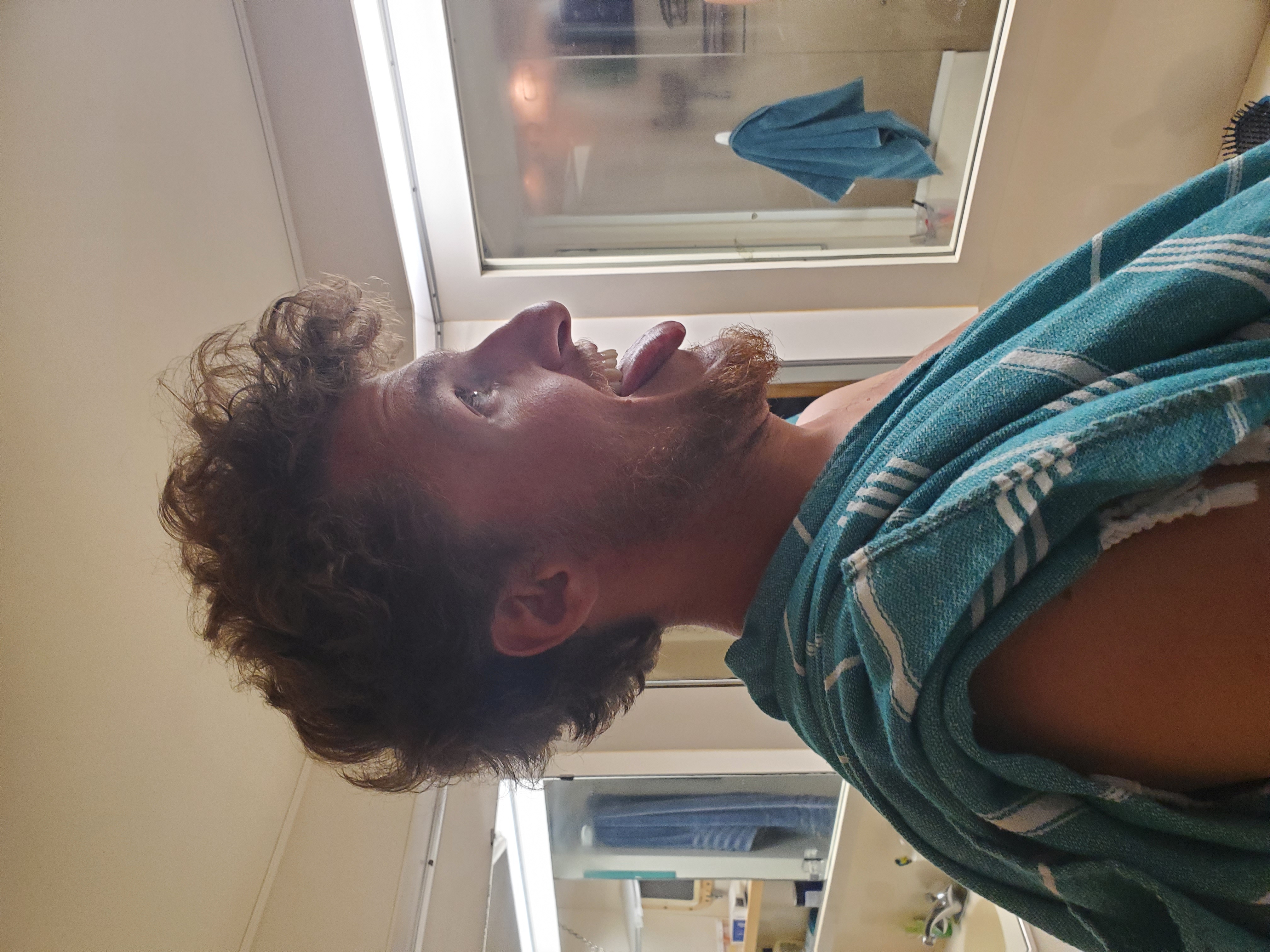
I was overdue for a cut to say the least
It also gave us an idea for a great service to offer out here. Just buy a rope light and run it outside where it’s visible to other boats, then program it to display the spinning red and white of a barber pole. The only other thing you would need is an open sign and business would be booming. Just pull up in your skiff, tie off, and sit down on the back deck for a quick ‘n easy haircut.
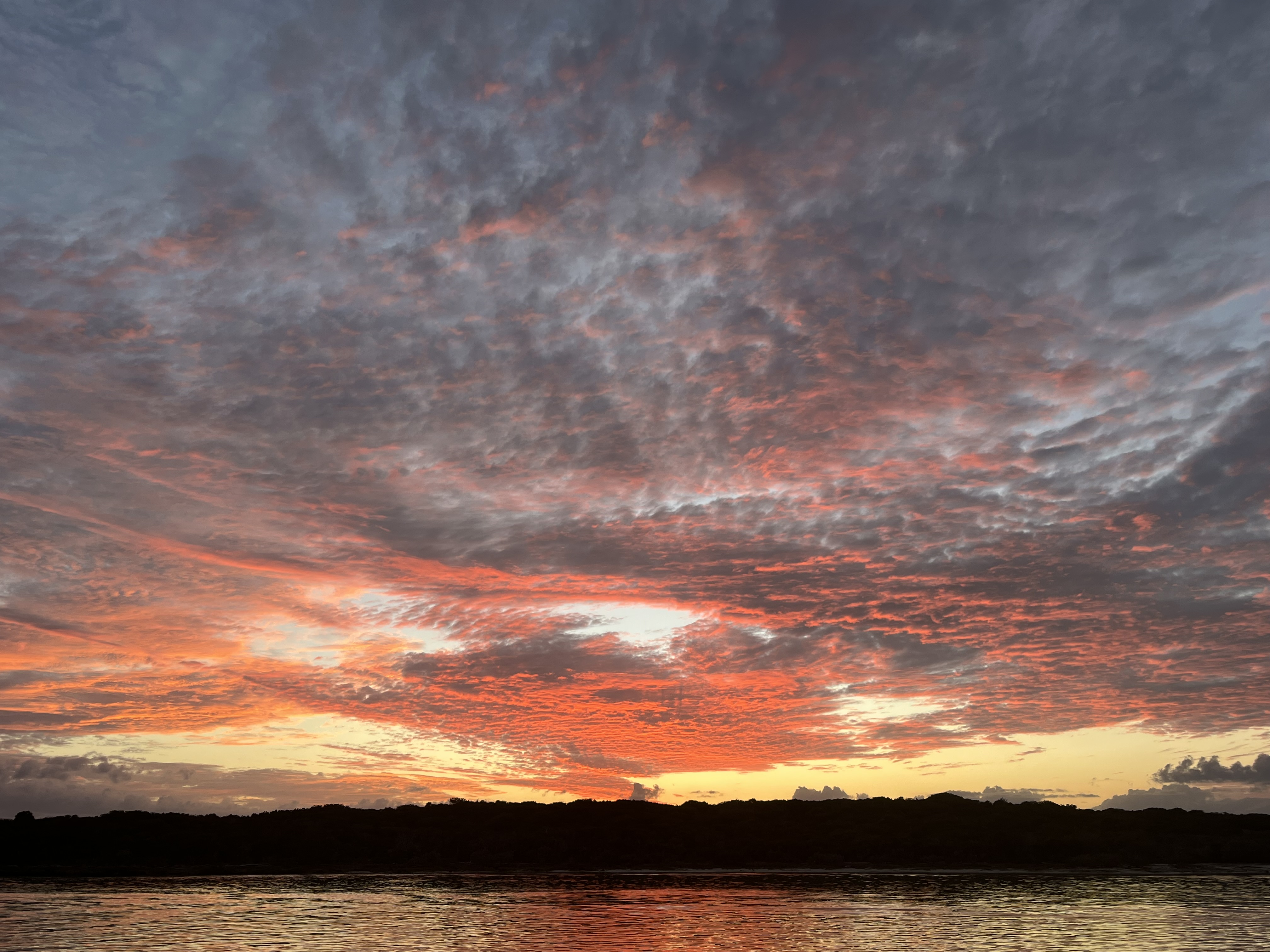
A gorgeous ending to a phenominal day